Cinthify is a socio-technical AI governance consultancy focused on the human systems, structures, and conditions that shape AI behaviour in practice. Governance should address where risk begins, not where it surfaces.
"We believe AI should be innovative, and we believe it can be. But innovation that comes at the expense of human well-being, dignity, or trust is not progress. It is risk deferred."
"AI Governance is Human Governance."
Most governance approaches focus narrowly on legal compliance, technical performance, and post-deployment oversight. They treat governance as a final checkpoint rather than a foundational practice.
Yet AI failures rarely begin at the model level. They begin upstream, in organisational decisions, workflow assumptions, accountability gaps, cultural dynamics, and insufficient literacy about what AI governance actually demands of people and institutions.
Cinthify exists to address these root causes before they scale into operational, ethical, or reputational harm. We work across the entire socio-technical environment surrounding AI systems, not just the systems themselves.
We champion AI innovation. We believe technology should push boundaries and change lives. But innovation cannot come at the expense of human well-being, dignity, accountability, or societal trust.
"Compliance is the floor. Governance is the house."Cinthify Foundational Principle
Our Philosophy
If you are an established enterprise, a public body, or an organisation deploying automated systems, you require governance structures that align with your operational reality rather than generic checklists. Whether you are managing third-party vendor risks or evaluating proprietary models, we assist teams in translating complex regulatory mandates into clear, actionable governance architecture.
Operating as an international practice, we support organisations deploying automated tools across global markets and high-growth regional hubs.
Designed for organisations requiring objective verification of their automated ecosystem. Whether you are developing proprietary machine learning models or onboarding third-party software, this process evaluates system impacts well beyond the basic code infrastructure. We analyse data provenance, the design decisions made throughout the pipeline, and the structural oversight mechanisms currently surrounding, or absent from, the system. The outcome is a structured, written assessment of your operational risk posture, designed to assist with Fundamental Rights Impact Assessment requirements, investor due diligence, and regulatory scrutiny.
Developed for established enterprises, state agencies, and cross-border commercial operators who utilise third-party automated software within their daily operations rather than developing software internally. We assist organisations in identifying unmanaged software exposure and establishing visibility over exactly where personnel may be utilising unauthorised public automated tools that risk data leaks or non-compliance with statutory frameworks.
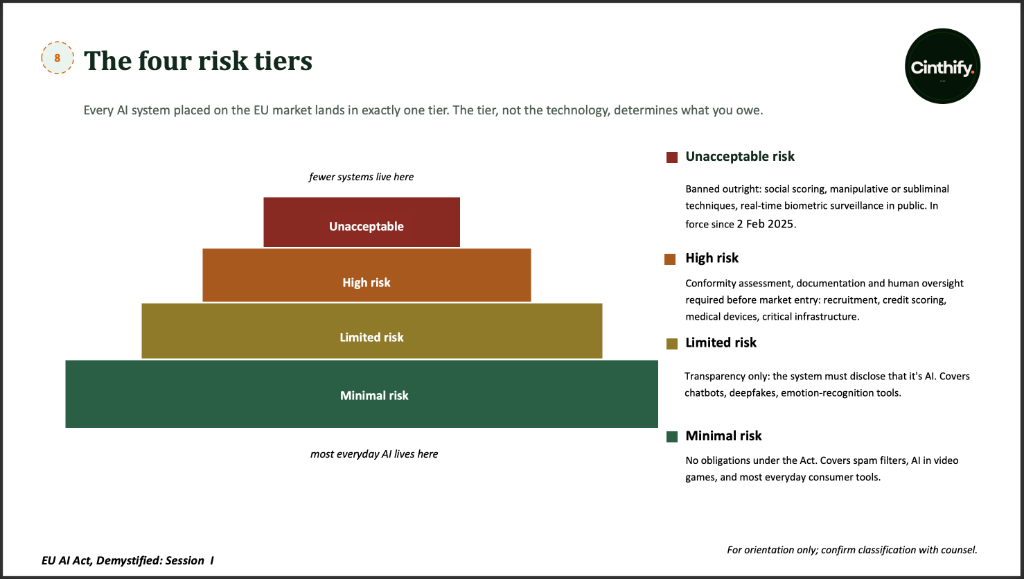
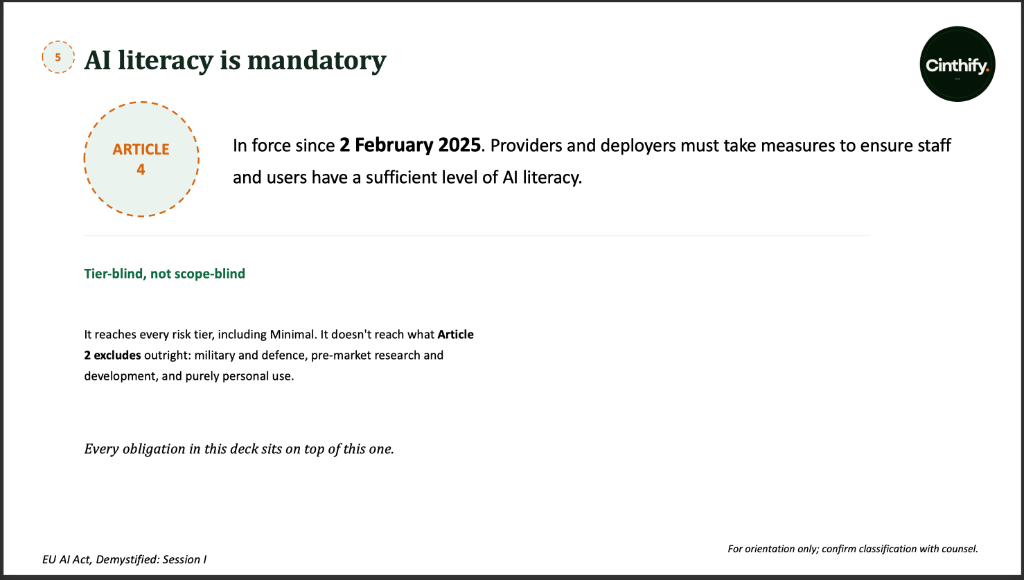
Under Article 4 of the EU AI Act, corporate boards, public bodies, and employers are required to ensure their personnel possess sufficient AI literacy. However, standard literacy often limits itself to basic technical utility. We elevate this requirement into AI Governance Literacy: the strategic capacity to identify, mitigate, and manage the regulatory, legal, and operational exposures associated with automated systems. We deliver role-specific, non-technical training modules designed for Directors, Company Secretaries, and Department Heads to support compliance with this statutory mandate.
While corporate secretarial and risk management teams possess deep expertise in traditional corporate law, they may lack specialised, certified training in algorithmic risk vectors. We act as an outsourced, fractional AI Governance advisor, supporting your internal Risk Committee on a retained monthly basis to review incoming vendor software contracts and maintain your ongoing governance infrastructure.
Technical AI literacy is simply understanding how an automated model functions under the hood. AI Governance Literacy is the structural capacity to prevent that model from exposing your organisation to regulatory sanctions, statutory liability, or formal enforcement actions. It provides the measured operational framework required to demonstrate verifiable compliance to regulators and the board.
We examine automated tools as systems deeply embedded within human and organisational realities, looking directly at how automated processes interact with institutional structures, user behaviours, and corporate frameworks. Whether preparing a Fundamental Rights Impact Assessment or an EU AI Office submission, we translate global policy into clear governance requirements, providing organisations with the structural stability to innovate and scale across international markets.
The socio-technical lens requires looking beyond the basic machine learning model into the institutional structures, communication pipelines, organisational incentives, and operational realities that dictate how automated processes function in practice.
We bridge the gap between algorithmic governance, human behaviour, organisational analysis, and AI Governance Literacy. Our methodology combines structural systems thinking, governance analysis, stakeholder engagement, and human-centred risk verification.
Discuss Your ChallengeWe begin where risk originates, in the strategic decisions, architectural structures, and operational assumptions made long before a system is deployed. Root cause verification is the foundation of our advisory practice.
Personnel are not isolated variables within automated loops; they constitute the operational environment. We analyse the socio-technical conditions: who retains decision-making authority, how parameters are established, and what institutional frameworks guide user behaviour.
Policy documentation that lacks operational integration is insufficient. We systematically assess and bridge the gap between formal policy registers and daily operational practices, as unmanaged risk resides within that variance.
Institutional cultures, power dynamics, and internal corporate incentives actively shape automated outcomes. We specialise in making these organisational forces visible, measurable, and governable.
Every strategic recommendation is developed to be deeply embedded within existing corporate architecture. Governance structures must be resilient enough to survive leadership transitions and technical updates.
As automated systems shape operational, reputational, legal, and societal outcomes, leadership teams require clear, systemic insight into the socio-technical risks surrounding AI adoption.
Cinthify bridges the communication gap between technical realities, organisational behaviour, corporate secretarial responsibilities, and executive oversight. We support organisations in ensuring that algorithmic risk is understood across every level of corporate accountability, not merely by the technical teams building the systems.
Leadership teams gain structured insight into automated risk vectors, translated from technical complexity into standard corporate governance metrics they can evaluate and act upon.
We identify where formal and operational accountability for automated systems resides across your enterprise, providing clarity before systemic exposures develop.
We evaluate how executive leadership culture influences risk appetite, and how those baseline protocols filter down to automated decisions across every level of the organisation.
We move beyond static policy checklists to establish dynamic governance frameworks that mature alongside your enterprise and the software it deploys.
Hycentina's path into automated systems risk was shaped by a clear professional conviction formed well before AI governance became a mainstream regulatory focus. Her MSc in Management and Corporate Governance and background in corporate law provide an essential lens often absent from traditional technology consulting: the understanding that systemic risk is fundamentally an organisational and human challenge.
By analysing how corporate boards fail, how accountability diffuses across institutions, how corporate cultures produce operational blind spots, and how legacy structures resist external scrutiny, she arrived at the foundational premise that guides Cinthify: AI Governance is an extension of Human and Institutional Governance. The technical architectures may evolve, but the underlying corporate dynamics remain consistent.
As a certified AI Governance Professional (AIGP) who actively contributes to global systemic risk frameworks through the Institute and Faculty of Actuaries (IFoA) working party, Hycentina brings structured, legally sound methodologies to a discipline that too often treats the technical layer as the sole concern. She founded Cinthify to address the significant practical variance between what AI governance looks like on paper and what it requires inside an enterprise attempting to execute it under strict regulatory timelines.
"The primary question is rarely limited to what the automated system executed. The core governance challenge is identifying what institutional conditions made that outcome possible, and who retains ultimate responsibility for those conditions."
Governance is not theoretical. It happens in rooms, in conversations, in decisions.
Traditional firms and cross-border commercial operators deploying third-party automated software across their operations who require structured visibility over unmanaged tool exposure, vendor risk mitigation, and a defensible compliance posture for regulators and the boardroom.
Public sector organisations navigating statutory AI mandates, from Article 4 literacy requirements to procurement-level algorithmic risk assessment, ensuring accountability without inflating internal administrative overhead.
Mid-market organisations moving from informal data practices to structured, operationally embedded accountability frameworks that function seamlessly under real-world conditions.
We also advise regulatory research bodies, legal networks, and policy organisations navigating these same technical maturity gaps at scale.
Algorithmic outputs possess traceable, systemic root causes. True governance addresses the institutional conditions creating those outputs rather than simply reacting to anomalies after they surface. This is a core professional conviction that shapes every engagement Cinthify undertakes.
We are not a checkbox compliance firm, nor do we support administrative inflation. We do not produce static policy registers that fail to survive contact with operational reality. Cinthify partners exclusively with organisations genuinely committed to understanding and managing what responsible, trustworthy automation requires of them.
Operating as a borderless enterprise practice, we bridge major international regulatory frameworks with the daily operational realities of organisations deploying automated tools worldwide. Our advisory practice spans the jurisdictions where socio-technical AI governance is now a strict statutory requirement, not an optional framework.
Cinthify Commons is a public learning initiative developed by Cinthify. It operates on the principle that digital and algorithmic literacy should not be an exclusive privilege reserved for software engineers, compliance officers, and institutional policy experts. Every citizen whose life, privacy, and livelihood are shaped by automated decision-making deserves access to clear, honest, and unjargoned knowledge.
"You do not require a computer science background to ask the foundational questions about automated power. You require structural clarity and an independent guide willing to translate complex parameters without condescension."
The vast majority of contemporary AI education is engineered for two specific audiences: technical practitioners building models, or corporate legal teams managing institutional risk. There is a distinct lack of resources developed for the individual who simply needs to understand what automated tracking means for their career, their financial privacy, their children, and their civil rights.
Cinthify Commons bridges this specific gap. We translate the exact socio-technical expertise that informs our institutional corporate work into accessible, practical knowledge for individuals, community advocates, educators, and anyone who recognises that the global conversation surrounding automation should happen with them, rather than above them.
Because automated systems actively impact daily social outcomes, everyone is a legitimate stakeholder in their oversight. You do not need to be a developer, an investor, or a policy director to have a lawful interest in how algorithms use your data. The systems being designed today will shape the infrastructure of the next generation. Cinthify Commons ensures the public has the literacy to step into the conversation.
"Uncertainty often stems from a variance in technical literacy. The strategic response is neither deference nor silence; it is structured understanding and the capacity to engage confidently with automated systems."
Structured, accessible explanations of the automated systems and technology-policy developments impacting daily life. No technical prerequisites, administrative jargon, or industry speculation. Just objective analysis of practical questions.
Browse Guides →A complimentary fortnightly publication engineered for interested individuals rather than industry specialists. Each issue analyses a specific automated workflow or policy development, translating complex mechanics into clear, practical observations for daily life.
Subscribe Free →Facilitated briefings, hosted both virtually and in person, allowing individuals to address technical and regulatory inquiries directly. These sessions operate as open dialogues designed to make automated governance concepts transparent, clear, and navigable.
Upcoming Sessions →Automated systems actively shape contemporary civic infrastructure, and public experience constitutes essential data. We collect real-world operational insights from individuals and transfer them directly into policy and institutional frameworks. Your observations serve as objective data for structural reform.
Share Your Concern →Access to structural policy dialogues remains highly asymmetric. Educational institutions, workforce development initiatives, and community organisations frequently navigate rapid technological shifts without dedicated technical advisory or compliance infrastructure. As automated systems integrate into core public and corporate sectors, establishing baseline risk literacy is essential to support career stability and institutional trust.
Cinthify Commons collaborates with academic institutions, civic organisations, and workforce initiatives to deliver structured AI governance literacy frameworks directly to public stakeholders. We bypass speculative technical projections to focus on practical, career-relevant knowledge that helps individuals identify what automated systems change, what they do not, and how to align their professional development with an automated market.
"Socio-technical outcomes are shaped by systemic institutional conditions. Cinthify Commons supports the public in developing the structural literacy required to actively participate in that oversight."
Access Cinthify Commons for complimentary guides, our fortnightly publication, and facilitated community sessions. We partner with academic institutions, civic organisations, and workforce initiatives to deliver structured AI governance literacy where it is needed most.
Complimentary for individuals. Sponsored by our institutional advisory work.
Join the Commons Partner With UsAnalytical insights and essays currently in development. Subscribe to receive formal notification upon publication.
Who we are. Cinthify is a socio-technical AI governance consultancy operating as a cross-border regulatory and enterprise advisory practice. Our contact address for data matters is: dialogue@cinthify.com.
What data we collect. When you submit an enquiry or subscribe to The Cinthify Brief, we collect the information you provide directly: name, email address, organisation, and role. We do not collect sensitive personal data. We do not purchase data or obtain it from third parties.
Why we collect it. We use your information solely to respond to your enquiry, to deliver the newsletter you subscribed to, and to maintain records of our professional correspondence. We do not use your data for automated profiling or decision-making.
How long we keep it. Enquiry data is retained for no longer than 24 months from the date of last contact. Newsletter subscriber data is retained for as long as you remain subscribed. You may request deletion at any time.
Your rights. Under applicable data protection law (including the GDPR where applicable), you have the right to access, correct, or erase your personal data; to restrict or object to its processing; and to data portability. To exercise any right, contact us at dialogue@cinthify.com.
Third-party processors. Enquiry and newsletter data is processed via Resend (email infrastructure). No data is sold or shared with third parties for marketing purposes.
A full, standalone Privacy Policy document is currently in preparation and will be published at cinthify.com/privacy prior to the formal site launch. This notice constitutes an interim statement of our data handling principles.
What are cookies. Cookies are small text files placed on your device when you visit a website. They are widely used to make websites function correctly and to provide information to site owners.
What this site currently uses. This website does not use tracking cookies, advertising cookies, or third-party analytics cookies. The site uses no cookie-based tracking of any kind at this time.
Embedded fonts. This site loads typefaces from Google Fonts. Google may set its own cookies or log request data in accordance with its own privacy policy. We have no control over those processes.
Contact form and newsletter. Form submissions are transmitted via Resend (our email infrastructure provider). No cookies are set by this process on your device.
Future changes. If this site introduces analytics, performance monitoring, or any cookie-based functionality in the future, this notice will be updated and an appropriate consent mechanism will be implemented before those tools are activated.
A full, standalone Cookie Policy document is currently in preparation and will be published at cinthify.com/cookies prior to the formal site launch. This notice constitutes an interim statement of our current cookie practices.